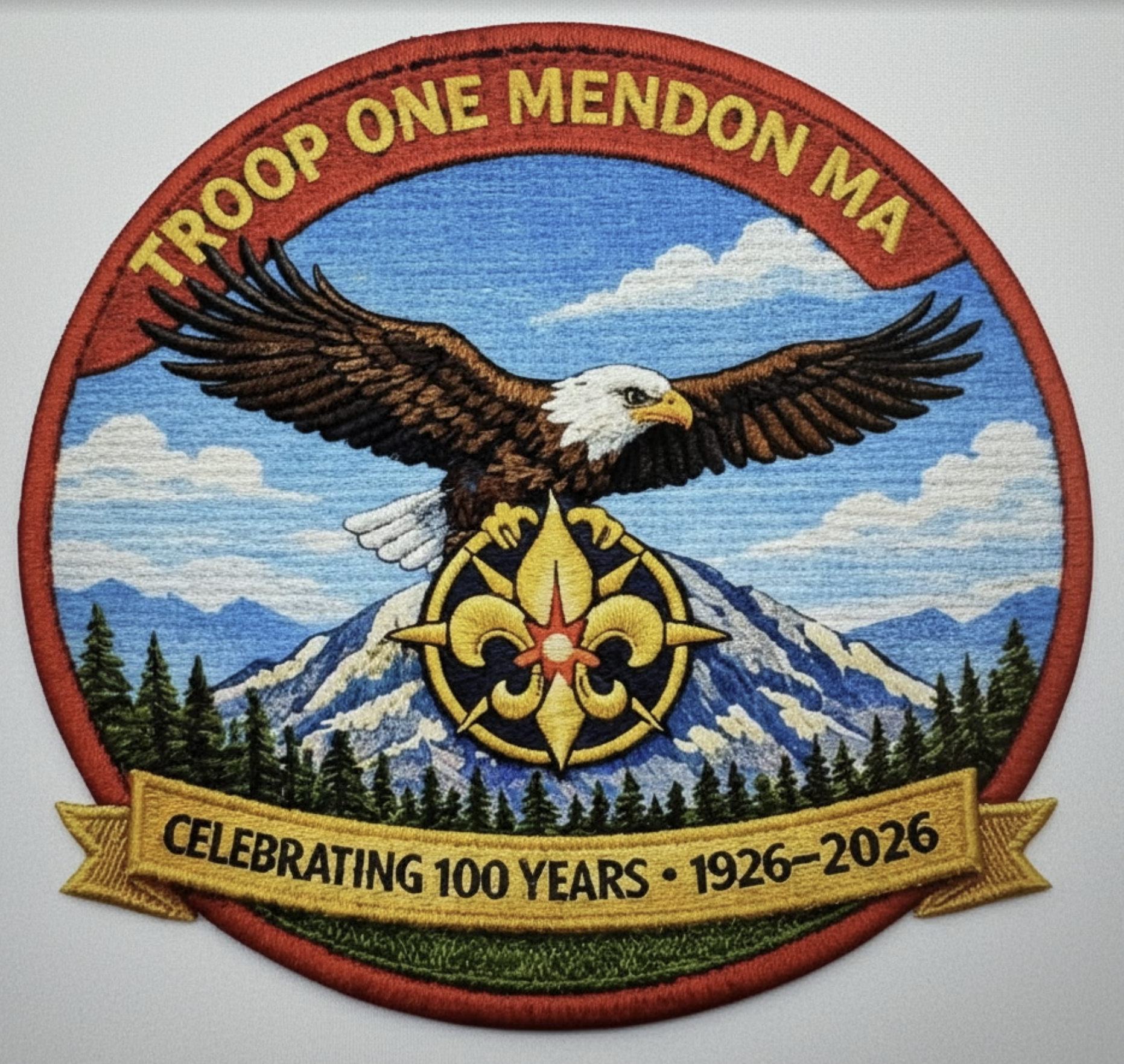
From the founding of a colonial town in 1667, to the chartering of Troop 1 Mendon in 1926 — and 100 years of hometown adventure since.
1667–Today Mendon, Massachusetts: 350+ Years of History
One of Worcester County's oldest towns, Mendon has played a quiet but consequential role in American history.
1660–1667 — Settlement & Founding
The area was first settled around 1660 by unofficial colonists. In September 1662, a deed was signed with Nipmuc leaders known as "Great John" and Quashaamit, purchasing the land — originally called Squinshepauke Plantation — for twenty-four pounds sterling. On May 15, 1667, Mendon was officially incorporated, becoming the second-oldest town in what is now Worcester County.
The land's original inhabitants were the Nipmuc people, whose name means "people of the fresh waters." Two Praying Indian villages established in Mendon's territory during this period reflect the complex relationship between colonists and Native communities in early New England.
1675–1680 — King Philip's War
On July 14, 1675, Mendon became the site of the first settler casualties of King Philip's War in the Massachusetts Colony, when violence reached the town and Benjamin Albee's grist mill — the first water-powered mill in the region, built in 1664 — was destroyed. By early 1676, Mendon had been largely burned to the ground.
The town was resettled and rebuilt beginning in 1680, and it would grow steadily in the years that followed. Among those who settled here after the war was Robert Taft Sr., an ancestor of the prominent Taft political family.
"Mother Mendon"
The original Mendon grant encompassed approximately 64 square miles. Over time, the town was subdivided into at least eight separate municipalities: Milford, Bellingham, Hopedale, Uxbridge, Upton, Blackstone, Northbridge, and Millville. Because of this, Mendon is traditionally called "Mother Mendon."
Bellingham became the first community to separate in 1719; Uxbridge followed in 1727. Despite losing much of its original territory, Mendon retained its distinct agricultural character — rolling hills, stone walls, weathered farm buildings — that distinguishes it from the neighboring industrial towns that grew around it.
1773 — The Mendon Resolves
One of Mendon's most significant contributions to American history came three years before the Declaration of Independence. A letter from Boston's Committee of Correspondence was read at a Mendon town meeting on February 10, 1773, prompting a committee of six ardent Sons of Liberty — Joseph Dorr, Edward Rawson, James Sumner, John Tyler, William Torrey, and Joseph Johnson — to draft a formal response.
On March 1, 1773, Joseph Dorr presented nineteen resolves at a town meeting:
“All men have naturally a right to life, liberty, and property, and … a just and lawful government must originate with the free consent of the people.”
The document also held that quartering an army in peacetime without the people's consent was a violation of the rights of free men.
Three years later, many of the Mendon Resolves' phrases reappeared in Thomas Jefferson's Declaration of Independence. Boston's Sons of Liberty took particular note of the document's eloquence. The Mendon Resolves remain a point of hometown pride — a town that put rights on paper three years before independence.
Lydia Chapin Taft: America's First Woman Voter
Lydia Chapin Taft (February 2, 1712 – November 9, 1778) was born in Mendon and is recognized as the first woman known to legally vote in colonial America. On October 30, 1756, in Uxbridge (a town that had separated from Mendon in 1727), she was permitted to vote at a town meeting in place of her late husband Josiah Taft — whose estate was the town's largest taxpayer — on whether to support the French and Indian War effort.
Under the principle of "no taxation without representation," her vote broke a tie — nearly two centuries before women's suffrage was enshrined in the U.S. Constitution. Since 2004, the Massachusetts legislature has named Route 146A from Uxbridge to the Rhode Island border in her honor.
Historical Landmarks
1669
Old Cemetery established — contains the graves of 40 Revolutionary War soldiers
1722
Milestone marker erected marking "37 miles from Boston" — now in Founders' Park
1745
Ammidon Tavern built
1769
Mendon Meetinghouse built, serving as worship space, town meeting hall, and community center
1825
Bank building constructed, now the Mendon Historical Museum
Nov 6, 1970
Rock band Aerosmith performed their first-ever concert at Miscoe Hill School (then Nipmuc Regional High School) in Mendon — locals remember the night & 55 years later
1986
Mendon included in the Blackstone River Valley National Heritage Corridor
1926–Today Troop 1 Mendon: 1926
A hometown troop, chartered in 1926, still going a century later.
Troop 1 Mendon: Chartered 1926
Troop 1 of Mendon, Massachusetts was chartered in 1926 — a hometown troop in a small New England town, built on outdoor skills, citizenship, and looking after your neighbor.
Nearly a century later, Troop 1 Mendon remains active and connected to its community. The 1926 Committee — the organizing body of this Centennial Gathering — takes its name from that founding year.
It is a fitting pairing: the town that put "life, liberty, and property" on paper in 1773 has now spent a century teaching citizenship and leadership to its young people. Troop 1's story is Mendon's story — and the next chapter is written October 9–11, 2026, at Inman Hill.
A Living Tradition: Pack 1 to Troop 1
A troop lasts a hundred years only because a new generation keeps crossing into it. For a century, Pack 1 families have grown up and stepped into Troop 1 — and that hand-off is still happening today.
The youngest taking their first steps at Inman Hill in 2026 are the ones who will carry Troop 1 into its second century — so the centennial isn't only a look back at 100 years, it's the next generation stepping into the story.
Roger L. Wood & American Legion Legacy
Troop 1 Mendon history is also tied to the local American Legion tradition and the memory of Roger L. Wood. Across generations, Legion values of service, citizenship, and duty to community have closely aligned with the troop's mission of youth leadership and character development.
That connection remains part of Troop 1 lore today — honoring veterans, civic responsibility, and hometown service. The Centennial Gathering recognizes this American Legion influence as part of the troop's 100-year story.
From the Troop Archives: 1952
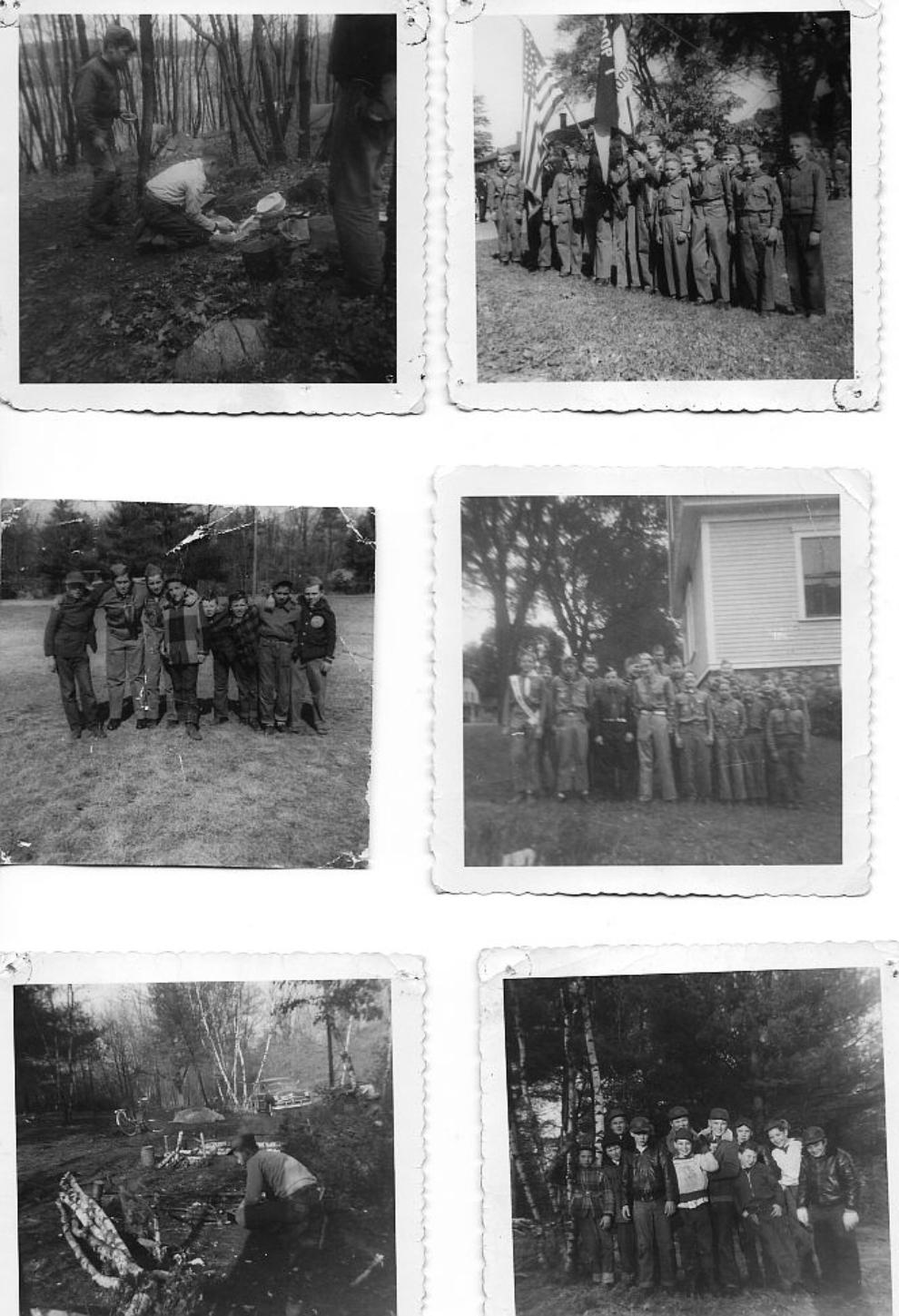
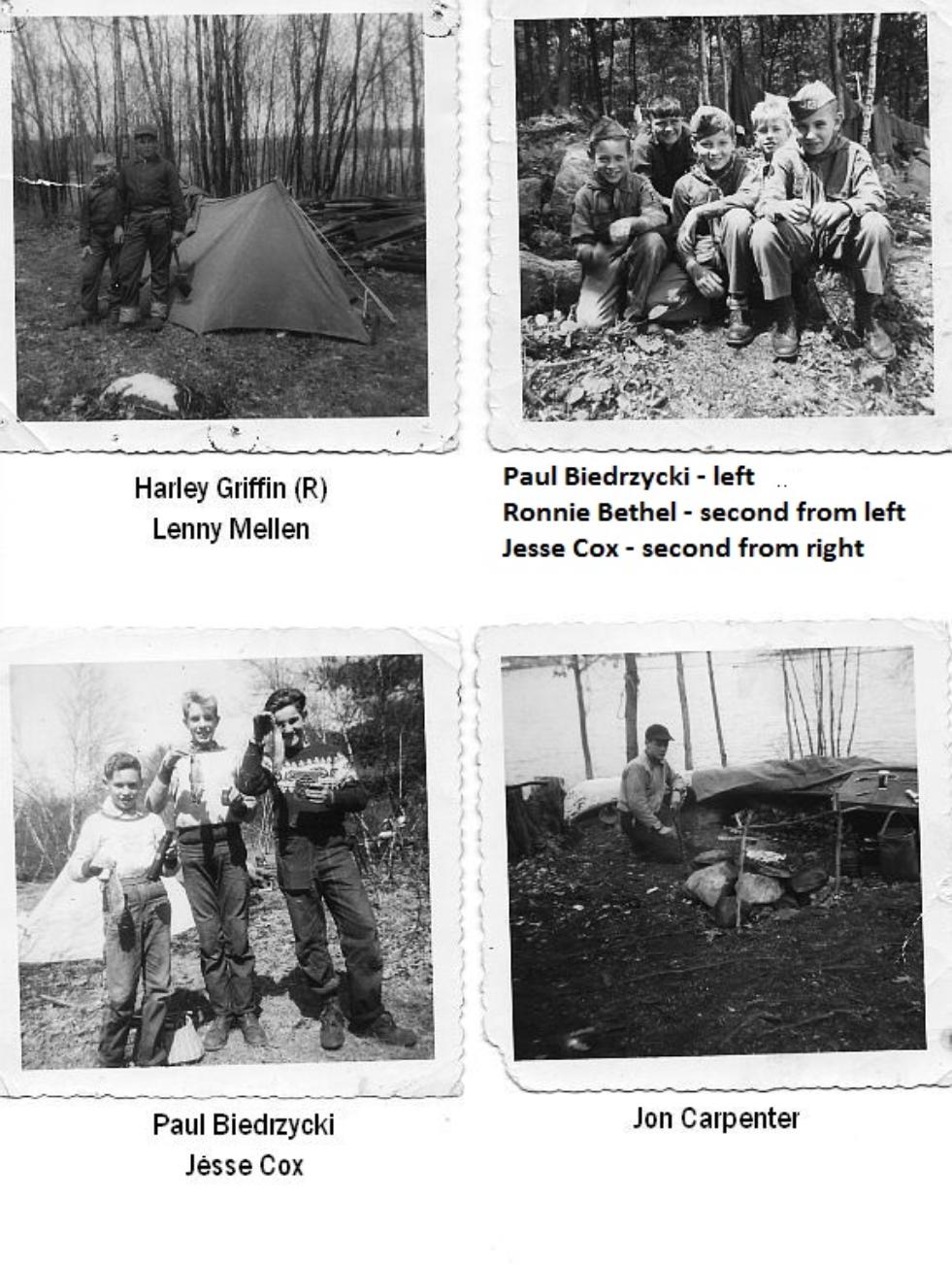
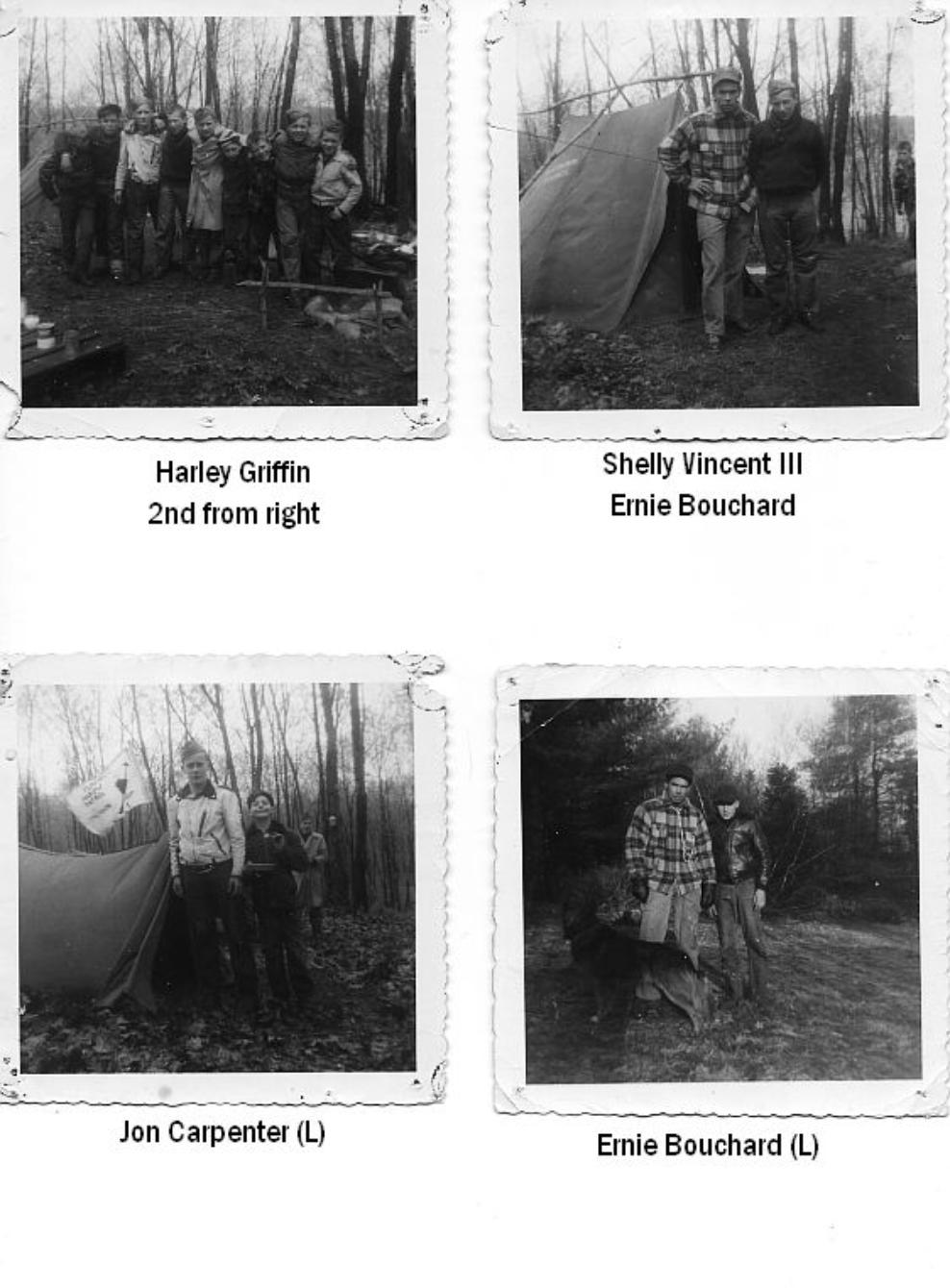
These scrapbook pages — snapshots from 1952, about a quarter-century into Troop 1's history — show Mendon youth doing exactly what they will be doing at Inman Hill in 2026: pitching canvas, cooking over fires, holding up the day's catch, and posing with the colors. Tap a page to view it full size.
Camp life, 1952 — cooking in the woods, the troop color guard with the American and troop flags, and group photos in the field.Names from the rolls — Harley Griffin, Lenny Mellen, Paul Biedrzycki, Ronnie Bethel, Jesse Cox, and Jon Carpenter, with a proud string of fish.Canvas tents and troop flags — Harley Griffin, Shelley Vincent III, Ernie Bouchard, and Jon Carpenter at camp, 1952.
Look closely at the names penciled onto these pages and then at the rolls below: a Shelley Vincent III is #3 (1954), a Jesse Cox is #5 (1956), and an Ernest Bouchard became a Troop 1 adult leader in 1953. Have photos or records from the troop's first century? Email info@mendoncentennialcamporee.org.
Troop archives: canvas tents, camp cooking, and names still on the rolls
1953
Ernest Bouchard begins a documented run of Troop 1 adult leadership
1969
Neil Armstrong becomes the first person to walk on the moon
2018–2019
Troop 1 and Pack 1 welcome girls into the hometown program
2022
Troop 1 Mendon's 100th name on the century roll — Brian Dubowik
2026
Troop 1 Mendon celebrates its 100th anniversary at the Centennial Gathering at Inman Hill
104 names A Century of Achievement
These names and dates are Troop 1 Mendon's century roll — young people who completed a demanding path of leadership, service, and outdoor skill. The table stays; the story is hometown achievement.
104
Names on Troop 1 Mendon's century roll
100
Years of Troop 1 Mendon (1926–2026)
1926
Troop 1 Mendon chartered
50
People at the 2026 Gathering (cap)
Century Roll — Troop 1 Mendon
Troop 1 Mendon names and dates, 1929 to present
No.
Name
Date
1
Clifford Entwhistle
1929
2
John Pharnes III
07/01/1954
3
Shelley Vincent III
07/01/1954
4
Edward Swanson
11/27/1954
5
Jesse Cox
1956
6
Richard Keohne
11/01/1959
7
Eugene Phillips
1961
8
Larry Pearson
1962
9
Dana Francis
1968
10
Theodore Giatis
1968
11
Michael Cousineau
10/08/1971
12
Scott Francis
06/28/1972
13
Cliff Mclaughlin
03/07/1973
14
William Baldiga
11/19/1973
15
Scott Waite
12/31/1973
16
Robert Pazella
01/15/1974
17
Ray Rondeau
05/05/1974
18
Alfred Gibson
06/10/1974
19
Tony Nardi
06/10/1974
20
William Giatis
08/21/1975
21
David Baldiga
10/08/1976
22
David Allaire
09/27/1977
23
Leonard Giatis
02/10/1979
24
Wayne Kreson
09/04/1979
25
Mark Pouliot
06/02/1980
26
James Rogers
03/16/1981
27
Michael L. Merolli
04/13/1981
28
Gary Bertrand
04/13/1981
29
Christopher Pouliot
04/20/1982
30
Fred Phipps
04/20/1982
31
Frederick Kelley
04/20/1982
32
Joel Boucher
07/16/1987
33
Edward Shea Jr
08/16/1990
34
Leonard Belliveau Jr
01/06/1991
35
Kenneth D. Belliveau
02/13/1994
36
Brian M. Belliveau
02/14/1994
37
Jason E. Tetreault
10/23/1994
38
Shawn P. Clafin
05/01/1995
39
Joel E. Tetreault
02/01/1997
40
Thomas R. Woodfin
05/21/1997
41
David J. Belliveau
09/17/1997
42
Jonathan P. Trotta
01/20/1998
43
Matthew T. Cook
05/24/1999
44
Jonathan G. Hurst
05/28/1999
45
Matthew S. Ruggiero
12/28/1999
46
Joseph A. Ethier Jr.
04/05/2000
47
Christopher J. Hurst
06/13/2001
48
Alexander P. Williamson
07/19/2001
49
Peter M. DeCampo
03/19/2002
50
David S. Vandervalk
06/27/2002
51
Joshua L. Tetreault
03/18/2003
52
Gregory W. Vincent
04/15/2004
53
Matthew J. Boczanowski
05/20/2004
54
Daniel R. Heumann
08/10/2004
55
Alan D. Tetrault Jr.
09/30/2004
56
Daniel F. DeCoster
11/30/2004
57
James G. Cialdea Jr.
01/20/2005
58
Jonathan E. Diotalevi
06/21/2005
59
Nathan A. Tetreault
06/21/2005
60
Peter M. Ballou
01/31/2006
61
Christopher M. Mehrmann
05/30/2006
62
Joey M. Lenzuolo
08/29/2006
63
Andrew S. Clinkman
03/15/2007
64
Benjamin T. Swartout
03/15/2007
65
Adam R. Klein
06/21/2007
66
Thomas M. Merolli
03/18/2008
67
Matthew E. Vincent
06/05/2008
68
Colby S. Crossman
06/24/2008
69
Nicholas R. Schofield
10/14/2008
70
Brett A. Flaherty
10/14/2008
71
Dana F. Perry
01/19/2010
72
Zachary S. Kennedy
01/19/2010
73
Paul J. Larson Jr.
04/08/2010
74
Richard W. Schofield III
02/08/2011
75
Spencer O. Hess
08/23/2011
76
Brandon R. Elliot
11/15/2011
77
Christopher R. Merolli
02/02/2012
78
Ian T. Jankauskas
03/20/2012
79
Liam F. Egan
04/04/2013
80
Michael S. Godowski
02/06/2014
81
Alexander Kennedy
07/10/2014
82
Austin B. LaBastie
09/02/2014
83
Shawn C. Clifton
11/20/2014
84
Zachary D. Schofield
09/15/2015
85
Conor W. Sweet
09/15/2015
86
Matthew G. O'Brien
10/20/2015
87
Jonathan M. O'Brien
10/20/2015
88
Jonathan J. Rivernider
05/12/2016
89
Colin Burgess
12/14/2016
90
Thomas Cavanaugh
12/28/2016
91
Aidan Belleville
11/13/2017
92
Zachary Rivernider
01/15/2018
93
Patrick W Kennedy
03/06/2018
94
Dillon J Elliott
03/06/2018
95
Sebastián Vázquez
07/17/2018
96
Aidan McCrae
01/31/2022
97
Andrew Nagda
03/01/2022
98
Jack Watchmaker
03/23/2022
99
Alex Rock
06/20/2022
100
Brian Dubowik
09/07/2022
101
Samuel Aubut
08/08/2023
102
Michael Byrne
01/24/2024
103
Giovanni Mistretta
01/29/2024
104
Conor Belleville
12/09/2024
Roll current through #104 (December 2024) per troop records. Entries showing a year only have an approximate date that is unconfirmed in surviving records. Spot a correction? Email info@mendoncentennialcamporee.org.
1926–Today Adult Leaders of Troop 1 Mendon
Across its century of history, Troop 1 Mendon has been guided by these dedicated volunteers.
Adult Leader Roll — Troop 1 Mendon
Adult leaders of Troop 1 Mendon and the years each served, 1926 to present
Name
Years Served
Under research
1926 – 1953
Ernest Bouchard
1953 – 1956
Ernest Koehne
1956 – 1966
Eugene Phillips
1966 – 1976
Donald Phillips
1976 – 1977
Stanley Rogers
1977 – 1985
Mike Merolli
1985 – 1987
Theresa Belliveau
1987 – 1989
Joe Ethier
1989 – 1992
Fred Gibson
1992 – 1997
Joe Boczanowski
1997 – 2002
Mike Merolli
2002 – 2013
Ken O'Brien
2013 – 2014
Thomas Cavanaugh
2014 – 2016
Jason Kuter
2016 – 2023
Joe Houde
2023 – 2026
The troop's adult leaders from 1926–1953 are still being researched. If your family kept records, newsletters, or photos from those early decades, the 1926 Committee would love to hear from you: info@mendoncentennialcamporee.org.
Historical content sourced from Wikipedia (CC BY-SA 4.0) and public domain sources. Troop 1 Mendon charter date per troop records; 1926 Committee archives.